New Year’s Eve Concert
Sergej Newski
“Goddess of History” for mezzo-soprano and orchestra, text by Thomas Venclova ”The Azov Campaign”
(2024, Auftragswerk des RSB, Deutsche Erstaufführung)
Ludwig van Beethoven
Symphony No. 9 in D minor, op. 125 with final choral of Schiller’s “Ode to Joy”
Vasily Petrenko
Conductor
Vasily Petrenko - Conductor

Vasily Petrenko is Music Director of the Royal Philharmonic Orchestra, a position he assumed in 2021, and which ignited a partnership that has been praised by audiences and critics worldwide. The same year, he became Conductor Laureate of the Royal Liverpool Philharmonic Orchestra following his hugely acclaimed 15-year tenure as their Chief Conductor from 2006–2021. He is the Associate Conductor of the Orquesta Sinfónica de Castilla y León, and has also served as Chief Conductor of the European Union Youth Orchestra (2015–2024), Chief Conductor of the Oslo Philharmonic Orchestra (2013–2020) and Principal Conductor of the National Youth Orchestra of Great Britain (2009–2013). He stood down as Artistic Director of the State Academic Symphony Orchestra of Russia ‘Evgeny Svetlanov’ in 2022, having been their Principal Guest Conductor from 2016 and Artistic Director from 2020.
He has worked with many of the world’s most prestigious orchestras, including the Berlin Philharmonic, Bavarian Radio Symphony, Leipzig Gewandhaus, London Symphony, London Philharmonic, Philharmonia, Accademia Nazionale di Santa Cecilia (Rome), St Petersburg Philharmonic, Orchestre National de France, Czech Philharmonic and NHK Symphony orchestras, and in North America has led the Philadelphia Orchestra, Los Angeles Philharmonic Orchestra, Cleveland Orchestra, and the San Francisco, Boston and Chicago Symphony orchestras. He has appeared at the Edinburgh Festival, Grafenegg Festival and BBC Proms. Equally at home in the opera house, and with over 30 operas in his repertoire, Vasily has conducted widely on the operatic stage, including at Glyndebourne Festival Opera, the Opéra National de Paris, Opernhaus Zürich, Bayerische Staatsoper and the Metropolitan Opera, New York.
Highlights of the 2025/26 season include tours with the Royal Philharmonic in Spain and the United States. He makes his debut with the Warsaw Philharmonic, and returns to conduct the Gewandhausorchester Leipzig, Oslo Philharmonic, Orchestre National de Lyon, Orchestre Philharmonique de Strasbourg, Dresden Philharmonic and the Houston Symphony, among others.
Recent highlights as Music Director of the Royal Philharmonic Orchestra have included wide-ranging touring across major European capitals and festivals, China, Japan and the USA. In London, recent acclaimed performances have included Mahler’s choral symphonies and concerts with Yunchan Lim and Maxim Vengerov at the Royal Albert Hall, performances at the BBC Proms, and the Icons Rediscovered and Lights in the Dark series. In the 2025–26 Season, at the Royal Albert Hall, they will perform three mighty Mahler’s symphonies alongside Bernstein’s Chichester Psalms and Korngold’s Violin Concerto. At the Royal Festival Hall, highlights include Shostakovich’s Symphony No.10, Messiaen’s Turangalîla-Symphonie, orchestral music from Wagner’s Parsifal and Scriabin’s Symphony No.3, ‘The Divine Poem’.
Vera-Lotte Boecker
Soprano
Christina Daletska
Mezzo / Alto
Benjamin Bruns
Tenor
Benjamin Bruns - Tenor

Benjamin Bruns began his singing career as an alto soloist with the boys’ choir in his home city of Hanover. After four years of private singing lessons with Prof. Peter Sefcik, he studied at the Academy of Music and Theatre in Hamburg under the Kammersängerin Renate Behle. While still a student, he was offered a permanent contract by the Theater Bremen, a position which allowed him to build up a broadly based repertoire at an early stage. It was followed by a similar contract with the opera house in Cologne. His professional journey then took him via the Dresden State Opera to the Vienna State Opera, where he remained a member of the ensemble until July 2021.
His musical roster contains Mozart roles such as Belmonte (Die Entführung aus dem Serail), Tamino (Die Zauberflöte) and Don Ottavio (Don Giovanni) but also other important repertoire like Fenton (Falstaff), Camille de Rosillon (The merry Widow), Lysander (Britten: A Midsummer Night’s Dream), Don Ramiro (La Cenerentola), Boris Grigorievič (Janáček: Kátia Kabanová) or the Italian Tenor in the Strauss operas Capriccio and Der Rosenkavalier. With Wagner roles like Lohengrin, Loge (The Rhinegold) and Erik (The flying Dutchman) or Matteo in Strauss’ Arabella he made his first steps into the light dramatic repertoire. In spring 2021 he had his debut as Florestan in Beethoven’s Fidelio (1804) at the Vienna State Opera.
Oratorio and lieder form an important counterweight to Benjamin Bruns’s stage work. At the heart of his extensive concert repertoire are the great sacred works by Bach, Handel, Haydn, Mozart, Schubert and Mendelssohn. He has sung with such renowned ensembles as the Berlin Philharmonics, the Sächsische Staatskapelle Dresden, the Boston Symphony Orchestra, the Munich Philharmonics, the Gewandhausorchester Leipzig, the Bach Collegium Japan, the WDR Symphony Orchestra as well as Choir and Orchestra of the Accademia di Santa Cecilia in Rome or the Akademie für Alte Musik Berlin.
Benjamin Bruns is an awardee of the Bundeswettbewerb Gesang (Federal Singing Competition) in Berlin, the Mozart Competition in Hamburg and the international singing competition of the Schloss Rheinsberg Chamber Opera. The very special honours accorded to him include the 2008 Kurt Hübner Prize awarded by the Theater Bremen and the 2009 Young Musicians’ Prize awarded by the Schleswig- Holstein Music Festival.
His last CD “Dichterliebe”, containing Schumann’s Dichterliebe and Der arme Peter, Beethoven’s An die ferne Geliebte as well as Hugo Wolf’s Liederstrauß (piano: Karola Theilll) was praised by the critics and nominated for both, the International Classical Music Awards and the Deutsche Schallplattenpreis.
Jordan Shanahan
Basso
Rundfunkchor Berlin
Rundfunkchor Berlin
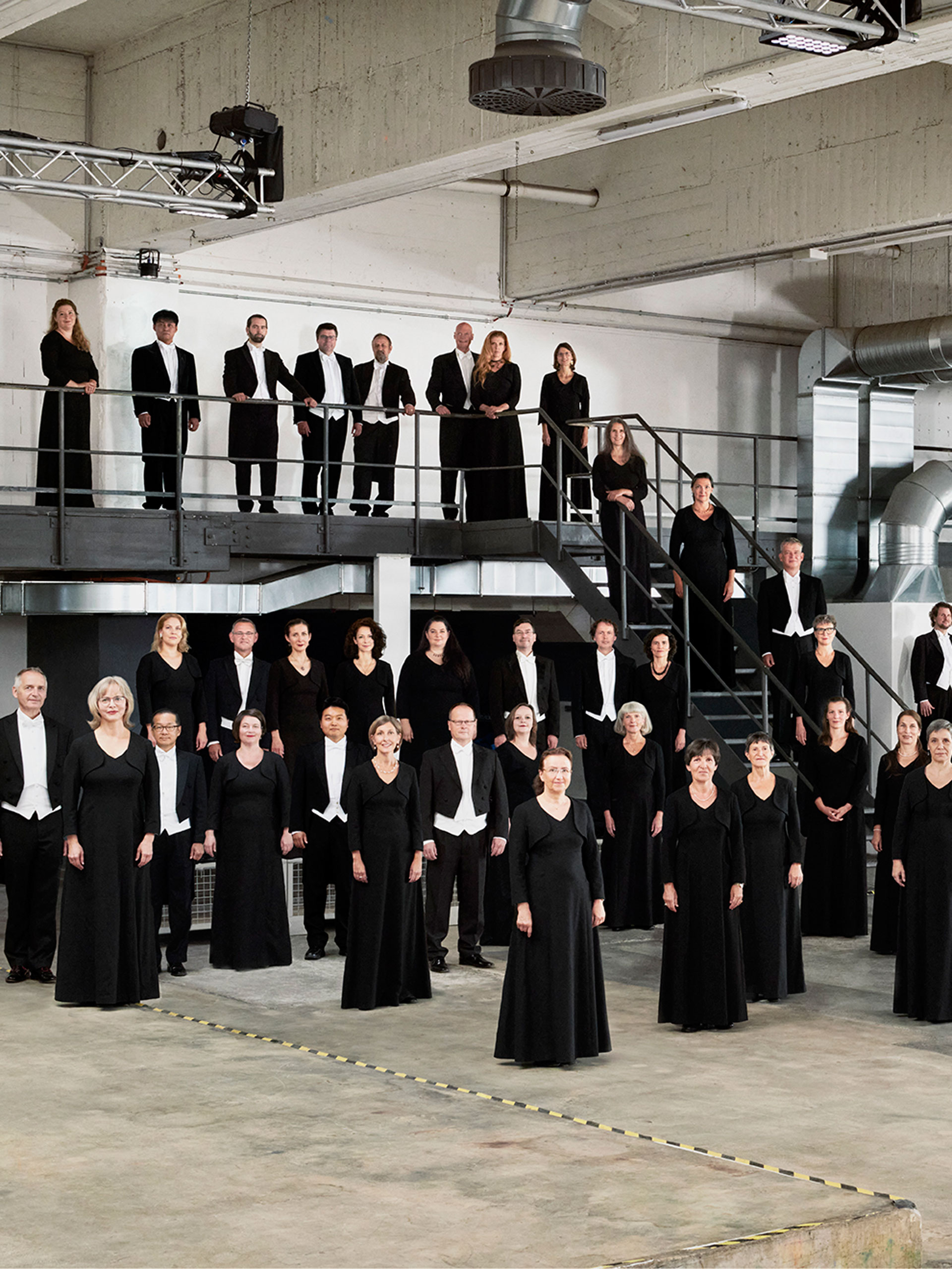
With around 60 concerts annually, CD recordings, and international performances, the Rundfunkchor Berlin is one of the world’s leading choirs. Three Grammy Awards alone stand as a testament to the quality of its recordings. Its wide-ranging repertoire, flexible, richly nuanced sound, flawless precision, and compelling presence make the professional choir a partner of choice for prominent orchestras and conductors, including Kirill Petrenko, Daniel Barenboim, Simon Rattle, and Yannick Nézet-Séguin. In Berlin, the choir has an intense collaboration with the Berliner Philharmoniker, the Deutsches Symphonie-Orchester Berlin, and the Rundfunk-Sinfonieorchester Berlin, as well as with their chief conductors.
The Rundfunkchor Berlin also attracts international attention with its interdisciplinary projects, which break the traditional concert format and offer new ways of experiencing choral music. A milestone was the staged interpretation of Brahms’ Requiem as a “human requiem” by Jochen Sandig and a team from Sasha Waltz & Guests. After performances in New York, Hong Kong, Paris, and Adelaide, the production traveled to Istanbul for the first time in the summer of 2019. For the project LUTHER dancing with the gods, the choir reflected on Luther’s impact on the arts and within the arts in a genre-defying concert performance with Robert Wilson and music by Bach, Nystedt, and Reich. For TIME TRAVELLERS, the choir will transform the Berliner Radialsystem into a walkable time tunnel in the 2019/2020 season. Based on Jonathan Dove’s composition The Passing of the Year, the project will create an interactive choral experience with films, images, performance, and music.
Through its community projects targeting diverse audiences – such as the large sing-along concert at the Berlin Philharmonie, the Festival of Choral Cultures for choirs from around the world, and the Song Market for Berlin students – the Rundfunkchor Berlin aims to inspire as many people as possible to sing. Its comprehensive educational program SING! focuses on the sustainable networking of various partners to promote singing as a natural part of Berlin’s elementary school curriculum. With the Academy and Schola, as well as the International Master Class Berlin, the ensemble is committed to nurturing the next generation of professional singers and conductors.
Founded in 1925, the Rundfunkchor Berlin celebrated its 90th anniversary in 2015. The choir has been shaped by conductors such as Helmut Koch, Dietrich Knothe (1982–93), Robin Gritton (1994–2001), and Simon Halsey (2001–2015). Since the 2015/16 season, Dutch conductor Gijs Leenaars has been the chief conductor and artistic director of the ensemble. Simon Halsey remains connected to the choir as an honorary conductor and guest conductor. The Rundfunkchor Berlin is an ensemble of the Rundfunk Orchester und Chöre GmbH Berlin, under the sponsorship of Deutschlandradio, the Federal Republic of Germany, the State of Berlin, and Rundfunk Berlin-Brandenburg.
Nico Köhs
Chorus Master
Rundfunk-Sinfonieorchester Berlin
It is with great regret that we must announce that Chief Conductor Vladimir Jurowski has had to cancel his appearances at the two New Year’s Eve concerts on 30 and 31 December for medical reasons. We wish him a rapid recovery and all the best.
At the same time, we are delighted that Vasily Petrenko has agreed to take over the baton for both concerts. Petrenko has been Music Director of the Royal Philharmonic Orchestra in London since 2021/22 and is very familiar with the orchestra as a regular guest conductor of the RSB.
We are particularly pleased that, in addition to Beethoven’s Symphony No. 9, he will also conduct Sergei Nevsky’s commissioned work ‘Goddess of History’, initiated by Vladimir Jurowski.
Brothers, above the starry sky must dwell a loving father
Ukraine, March 2022.
“… beautiful weather – the offspring, born in bunkers, will look at it with fear, for the sky is a nuclear threat, not the place where God dwells.”
The oppressive poem “The Azov Campaign” by Lithuanian poet Thomas Venclova refers to the siege of Mariupol by the Russian military in the spring of 2022. It is the subject of the stirring composition “Goddess of History” by Russian composer Sergej Newski, who lives in exile in Berlin. In 2025, Vladimir Jurowski will precede the traditional performance of Beethoven’s Symphony No. 9, with its Ode “To Joy,” with this composition.
In ten verses, Venclova focuses on the specific events in eastern Ukraine and elevates them to an epic statement rooted in ancient tradition. “The human voice mutates from quasi-folkloric singing to rap and extended techniques, culminating in a long improvisational solo accompanied by a rhythmic ostinato in the bass.” (Sergej Newski)
Number Nine
Richard Wagner felt magically drawn to it throughout his life while Hermann Hesse was repelled by the vulgar banality of its finale. The German workers’ singing movement turned it into a regular mass event in the 1920s, while Claude Debussy, seeing it become so widely popular, thought its greatness was reduced to mere spectacle. Thomas Mann’s fictional character Adrian Leverkühn wanted to reject it once and for all. The Rundfunk-Sinfonieorchester Berlin has been playing it regularly at the turn of the year since 1948 – not because it is customary, but because this special work, Ludwig van Beethoven’s Symphony No. 9, helps people around the globe to lift their inner selves higher and reach for the stars.
Concert with Deutschlandfunk Kultur. Broadcast on December 31, 2025, at 8:07 p.m.
Concert with

Cooperation partner

Storytelling concert Shelly Kupferberg
Schubert, Tchaikovsky, Tiessen, Kupferberg
Moderated rehearsal with Dima Slobodeniouk & Xavier de Maistre
Saariaho