Karol Szymanowski
“Stabat mater” for soloists, choir and orchestra op. 53
Gustav Mahler
Symphony No. 4 in G major
Edward Gardner
Conductor
Edward Gardner - Conductor

Edward Gardner is Principal Conductor of the London Philharmonic Orchestra and Music Director of The Norwegian Opera and Ballet. He additionally serves as Honorary Conductor of the Bergen Philharmonic Orchestra, following his tenure as Chief Conductor from 2015 to 2024.
Edward opens his inaugural season as Music Director of The Norwegian Opera and Ballet with concert performances of Wagner The Flying Dutchman and Mahler Symphony No. 2 ‘Resurrection’. He will then conduct two fully staged operas; Verdi La Traviata and Janáček The Cunning Little Vixen, following earlier productions of Bartok Bluebeard’s Castle, Zemlinsky A Florentine Tragedy and Verdi Un ballo in Maschera.
During his fourth season with the LPO, Edward will conduct nine concerts at the Royal Festival Hall as well as a US tour culminating at Carnegie Hall, and in major European cities including Vienna, Frankfurt and Hamburg. Highlights of their London season include Strauss Alpine Symphony, Ravel and Rachmaninov double bills and several world premieres, closing with Mahler Symphony No.8 Symphony of a Thousand.
In demand as a guest conductor, this season Edward appears with Symphonieorchester des Bayerischen Rundfunks, Frankfurt Radio, Dallas Symphony, New World Symphony, Minnesota Orchestra, Seoul Philharmonic, Sydney Symphony and West Australian Symphony Orchestras. Debuts in recent seasons include New York Philharmonic, The Philadelphia and Cleveland Orchestras, San Francisco Symphony, Staatskapelle Berlin Orchestra, Rundfunk-Sinfonieorchester Berlin, and Wiener Symphoniker; with re-invitations to Gewandhausorchester Leipzig, Montreal Symphony, Deutsches Symphonie-Orchester Berlin, and Orchestra del Teatro alla Scala di Milano. In the UK he has had longstanding collaborations with the City of Birmingham Symphony Orchestra, where he was Principal Guest Conductor from 2010-16, and the BBC Symphony Orchestra, whom he has conducted at both the First and Last Night of the BBC Proms.
In Spring 2025 Edward returned to the Royal Opera House to conduct the world premiere of Mark-Anthony Turnage Festen having made his debut with a new production of Káťa Kabanová, and he returned to Bayerische Staatsoper in June for Rusalka, following his debut with Peter Grimes in 2022 and Verdi Otello in 2023. Music Director of English National Opera for eight years (2007-15), Edward also built a strong relationship with The Metropolitan Opera with productions of Damnation of Faust, Carmen, Don Giovanni, Der Rosenkavalier and Werther. Elsewhere, he has conducted at La Scala, Chicago Lyric Opera, Glyndebourne Festival Opera and Opéra National de Paris.
Edward has an extensive discography with Chandos. His many recordings with the Bergen Philharmonic feature Brahms, Sibelius, Nielsen, Grieg, Bartok, Schoenberg and Britten, and their recording of Janáček Glagolitic Mass received a Grammy nomination. His recording of Tippett The Midsummer Marriage for LPO Live received the Gramophone Opera Award 2023 and their most recent release is Berlioz The Damnation of Faust.
A passionate supporter of young talent, Edward founded the Hallé Youth Orchestra in 2002 and regularly conducts the National Youth Orchestra of Great Britain. He has a close relationship with the Juilliard School of Music, and with the Royal Academy of Music who appointed him their inaugural Sir Charles Mackerras Conducting Chair in 2014.
Born in Gloucester in 1974, Edward was educated at Cambridge and the Royal Academy of Music and gained early recognition as Assistant Conductor of The Hallé and Music Director of Glyndebourne Touring Opera. His many accolades include the Royal Philharmonic Society Conductor of the Year Award (2008), an Olivier Award for Outstanding Achievement in Opera (2009) and an OBE for Services to Music in the Queen’s Birthday Honours (2012).
Amanda Majeski
Soprano
Amanda Majeski - Soprano

Internationally renowned American soprano Amanda Majeski is a celebrated interpreter of Mozart, Strauss, Wagner and Handel. She is also highly acclaimed for her portrayal of Janáček’s Káťa Kabanová, making her debut with that role at the Royal Opera House, Covent Garden (Best New Opera Production at the 2019 Olivier Awards), and having been described as “Katya of the moment”, following the London Symphony Orchestra concert performance conducted by Sir Simon Rattle in 2023.
On the concert platform Majeski has performed with the Los Angeles Philharmonic (cond. Gustavo Dudamel), Boston Symphony Orchestra, London Symphony Orchestra, Sydney Symphony Orchestra, Nürnberger Symphoniker and the Sinfonieorchester Aachen. Her performance of Gutrune Götterdämmerung with the Hong Kong Philharmonic cond. Jaap van Zweden was released on Naxos Records. Her many recital appearances have included Italienisches Liederbuch at 92nd Street Y with pianist Julius Drake and her solo recital debut at Carnegie Hall.
Majeski holds degrees from the Curtis Institute of Music and Northwestern University. She was a member of San Francisco Opera’s Merola Program, the Gerdine Young Artist Program at Opera Theatre of St. Louis, and the Steans Institute at Ravinia, and is alumnus of the Ryan Opera Center. Awards include the George London Foundation Award, first prize of the Palm Beach Opera Vocal Competition, and a Sara Tucker Study Grant from the Richard Tucker Foundation.
Agnieszka Rehlis
Alto
Kostas Smoriginas
Baritone
Kostas Smoriginas - Baritone

Lithuanian bass-baritone Kostas Smoriginas is one of the most sought-after singers of today. Known for his “smouldering, god’s-gift” voice as well as his “complete performance” Kostas can “command the stage with a single phrase” and “sings as well as he acts.”
Kostas Smoriginas is one of the most sought after bass-baritones of today. He made his debut at the Deutsche Staatsoper, Berlin as Escamillo Carmen and has since performed the role with the Berlin Philharmonic and Sir Simon Rattle (recorded for EMI Classics), the Salzburg Easter Festival, Royal Opera House Covent Garden, Santa Fe Music Festival, Dresden Semperoper, and with Beijing’s National Centre for Performing Arts.
Last season Smoriginas sang Jochanaan Salome with the houses of Hannover, Antwerp and Malmö, and in his return to the Zurich Opera House, performed Verdi Requiem with the Deutsches Symphonie-Orchester Berlin, and made his Bayerische Staatsoper debut as Heerrufer des Königs Lohengrin, alongside René Pape and Piotr Beczała.
In high demand on the concert platform, engagements have included Szymanowski’s Stabat Mater with the City of Birmingham Symphony Orchestra (Edward Gardner) and London Symphony Orchestra (Valery Gergiev), Stravinsky Les Noces and Beethoven Symphony No. 9 at the BBC Proms, Dvorak Te Deum with the Orchestre de Paris, Beethoven Symphony No. 9 with the Frankfurt Radio Orchestra, Rachmaninov The Bells with the Boston Symphony Orchestra (Andris Nelsons) and Shostakovich Symphony No. 13 with the Czech Philharmonic Orchestra. He recorded the role of Pietro Simon Boccanegra alongside Dmitri Hvorostovsky, Ildar Abdrazakov and Barbara Frittoli.
Smoriginas studied at the Lithuanian Music and Theatre Academy before representing his country at the BBC Cardiff Singer of the World Competition. He graduated from the Royal College of Music and was a member of the Jette Parker Young Artist Programme at the Royal Opera House.
Rundfunkchor Berlin
Rundfunkchor Berlin
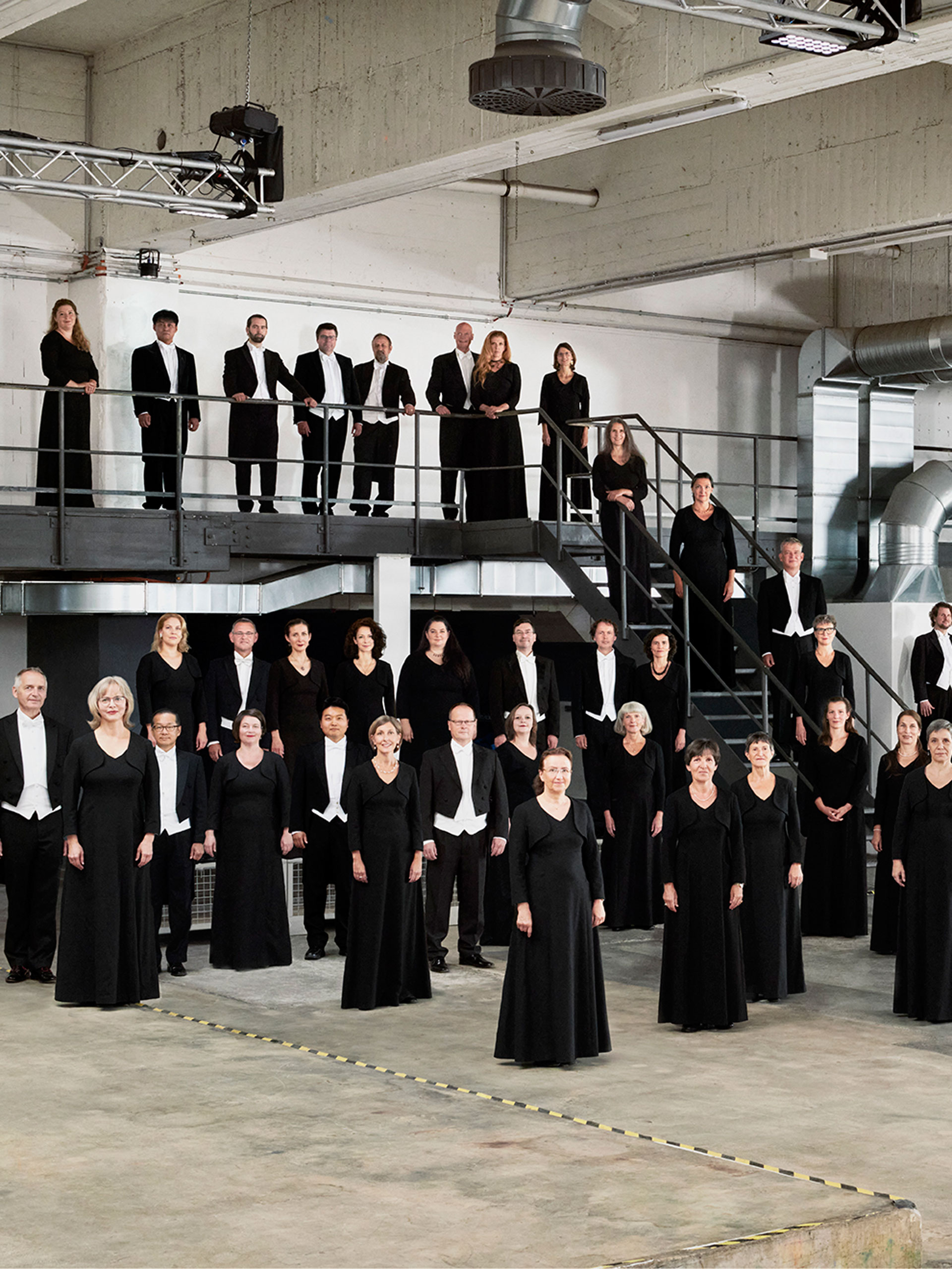
With around 60 concerts annually, CD recordings, and international performances, the Rundfunkchor Berlin is one of the world’s leading choirs. Three Grammy Awards alone stand as a testament to the quality of its recordings. Its wide-ranging repertoire, flexible, richly nuanced sound, flawless precision, and compelling presence make the professional choir a partner of choice for prominent orchestras and conductors, including Kirill Petrenko, Daniel Barenboim, Simon Rattle, and Yannick Nézet-Séguin. In Berlin, the choir has an intense collaboration with the Berliner Philharmoniker, the Deutsches Symphonie-Orchester Berlin, and the Rundfunk-Sinfonieorchester Berlin, as well as with their chief conductors.
The Rundfunkchor Berlin also attracts international attention with its interdisciplinary projects, which break the traditional concert format and offer new ways of experiencing choral music. A milestone was the staged interpretation of Brahms’ Requiem as a “human requiem” by Jochen Sandig and a team from Sasha Waltz & Guests. After performances in New York, Hong Kong, Paris, and Adelaide, the production traveled to Istanbul for the first time in the summer of 2019. For the project LUTHER dancing with the gods, the choir reflected on Luther’s impact on the arts and within the arts in a genre-defying concert performance with Robert Wilson and music by Bach, Nystedt, and Reich. For TIME TRAVELLERS, the choir will transform the Berliner Radialsystem into a walkable time tunnel in the 2019/2020 season. Based on Jonathan Dove’s composition The Passing of the Year, the project will create an interactive choral experience with films, images, performance, and music.
Through its community projects targeting diverse audiences – such as the large sing-along concert at the Berlin Philharmonie, the Festival of Choral Cultures for choirs from around the world, and the Song Market for Berlin students – the Rundfunkchor Berlin aims to inspire as many people as possible to sing. Its comprehensive educational program SING! focuses on the sustainable networking of various partners to promote singing as a natural part of Berlin’s elementary school curriculum. With the Academy and Schola, as well as the International Master Class Berlin, the ensemble is committed to nurturing the next generation of professional singers and conductors.
Founded in 1925, the Rundfunkchor Berlin celebrated its 90th anniversary in 2015. The choir has been shaped by conductors such as Helmut Koch, Dietrich Knothe (1982–93), Robin Gritton (1994–2001), and Simon Halsey (2001–2015). Since the 2015/16 season, Dutch conductor Gijs Leenaars has been the chief conductor and artistic director of the ensemble. Simon Halsey remains connected to the choir as an honorary conductor and guest conductor. The Rundfunkchor Berlin is an ensemble of the Rundfunk Orchester und Chöre GmbH Berlin, under the sponsorship of Deutschlandradio, the Federal Republic of Germany, the State of Berlin, and Rundfunk Berlin-Brandenburg.
Gijs Leenaars
Chorus Master
Gijs Leenaars - Chorus Master

Gijs Leenaars has been at the helm of the Rundfunkchor Berlin as Chief Conductor and Artistic Director since the 2015/16 season. Since then, he has worked with outstanding conductors such as Kirill Petrenko, Daniel Barenboim, Simon Rattle and Yannick Nézet-Séguin. Gijs Leenaars conducts cross-genre concert performances such as the “human requiem” or “LUTHER dancing with the gods” and is responsible for recordings of a cappella repertoire and choral symphonic works. In the 2019/20 season, he will conduct the major festival of choral cultures and the transdisciplinary project “TIME TRAVELLERS”. He will also conduct Bruckner’s Mass in E minor in the Kaiser Wilhelm Memorial Church to mark the 30th anniversary of the fall of the Berlin Wall, a work that will also be released on CD with this instrumentation.
Born in Nijmegen in 1978, the Dutchman is one of the most interesting choral conductors of the younger generation. He studied piano, choral and orchestral conducting and singing in Nijmegen and Amsterdam. His collaboration with the Dutch Radio Choir in Hilversum began immediately after graduating. From 2012 to 2015, he was chief conductor of the ensemble and worked as such with Mariss Jansons, Nikolaus Harnoncourt and Bernard Haitink. He is also a regular guest conductor of the Collegium Vocale Gent, the Cappella Amsterdam and the Nederlands Kamerkoor. He has also worked with orchestras such as the Dutch Radio Symphony Orchestra, the Rotterdam Philharmonic Orchestra, the Residentie Orkest Den Haag and the Orchestra Filarmonica di Torino.
He is particularly interested in performing contemporary music. For example, Gijs Leenaars conducted the Dutch premiere of Wolfang Rihm’s “Vigilia”, and for the complete recording of Kurtág’s works under Reinbert de Leeuw, he worked on the choral works with the Dutch Radio Choir. In his programs, he combines classical repertoire with rarely heard works of choral literature.
Rundfunk-Sinfonieorchester Berlin
Life in heaven
“How much more understandable to me, emotionally speaking, are those simple words: ‘Stała Matka bolejąca, koło krzyża łzy lejąca’ than those words which are equally understandable to me conceptually: Stabat Mater dolorosa juxta crucem lacrimosa…” When composing his Stabat mater in 1926, the Polish composer Karol Szymanowski was not concerned with creating a piece of church music that could be used liturgically, but rather a work of music springing from deep human feeling and personal sympathy, a musical prayer that did not need a church interior to resonate. Wonderfully heretical and at the same time, or perhaps precisely because of this, full of honest ethos, Szymanowski continues: ‘This is religious music: it therefore also had to be far removed from official liturgical music.’
Gustav Mahler’s Symphony No. 4 ranks on the same level. Its finale consists of the song ‘Das himmlische Leben’ (“The Life in Heaven”), which Mahler borrowed from the folk song collection ‘Des Knaben Wunderhorn’ (“The Boy’s Magic Horn”). According to Mahler, a“ voice with a childlike, cheerful expression, utterly without parody” should intone this heavenly song of drinking and feasting, of joking about the slain lamb, the slaughtered ox, the baited fish, the plucked herbs, the plundered orchards, the deer and hares that died on the open road and, of course, the wine that costs nothing to drink. All this food becomes hard to swallow at the thought that heaven should resemble the domain of the darkest pirates and most shameless plunderers. What begins as a hearty song of praise to earthly pleasures reveals itself to be a defiant, touchingly rustic prayer from those who, with desperate optimism, are compelled to rejoice in that which they do not have. Bereft of any real quality of life on earth, they cling, without alternative, to the hope of a heavenly life to come.
Concert broadcast: The concert will be broadcast on Deutschlandfunk Kultur on 20 November at 8 p.m.
Concert with

Cooperation partner

Cooperation partner
