Chamber concert Kühlhaus


Alexander Zemlinsky
"Humoresque" for wind quintet
Darius Milhaud
"La cheminée du roi René" - Suite for wind quintet op. 205
Jonas Kern
Linear Cycles 01
Meditational Improvisation for 2-21 Musicians
Fassung für Bläserquintett und Live-Elektronik
Paul Hindemith
"The little electric musician's favourites" - Seven pieces for three trautoniums, arranged for oboe, clarinet and bassoon
Compositions for one to five acoustic wind instruments and electronics
Benjamin Bacon
Gesture Contours I-III, modular score (graphic) for acoustic and electronic instruments
Grgur Savic
"ETERNAL FORCES OF SAVIGNY'S PRIME", Digital-animated graphic composition
Kurt Weill
Songs from "The Threepenny Opera" - arranged for wind quintet by Alan R. Kay
Jonas Kern
Live-Elektronik
Rudolf Döbler
Flute
Rudolf Döbler - Flute

Play – communicate – inspire. Rudolf Döbler pursues these goals as a musician, lecturer, presenter and music educator.
Rudolf Döbler was born in Achern (Ortenau) in 1966. He studied with William Bennett and John Wright at the music academies in Freiburg and Karlsruhe. He also attended master classes with Alain Marion, Michel Debost, James Galway, André Jaunet, Geoffrey Gilbert and Robert Dick. His first engagements took him to the philharmonic orchestras in Dessau and Hagen as principal flute.
Since 1993 he has been deputy principal flute with the Rundfunk-Sinfonieorchester Berlin (RSB). Parallel to his orchestral activities, he was a member of the ensemble musikFabrik NRW, one of the leading German ensembles for contemporary music, from 1995 to 1997. He is a member of the “14 Berliner Flötisten” and the ensemble 7211.
Together with the Dutch flautist Robert Pot, Rudolf Döbler has been teaching advanced amateurs and professionals in master classes since 2002. He has been artistic director of the QUERWIND Flute Days Staufen since 2009.
Rudolf Döbler has been passionate about inspiring people for music ever since he has been on stage. His carefully chosen presentations of his own chamber concerts, his experience as a children’s concert presenter and his commitment as a school representative of the RSB are evidence of this. Since 2005, he has been coordinating, organizing and designing workshops and rehearsal visits for Berlin schools and kindergartens
Gudrun Vogler
Oboe
Gudrun Vogler - Oboe

Gudrun Vogler has been an oboist and English horn player with the Berlin Radio Symphony Orchestra since 2002.
From 1988 to 1992, she was the principal oboist at the National Theatre Weimar.
As a two-time prizewinner of the ARD Music Competition in the field of chamber music with the wind quintet “Kammervereinigung Berlin,” she recorded CDs with this ensemble for renowned labels, initially performing extensively throughout Germany and later internationally.
As a member of the specialized ensemble for contemporary music “KNM Berlin,” where she was active from 1992 to 2019 and performed in cities such as Buenos Aires, Tokyo, and Taipei, she explored her role as an instrumentalist, performer, and creative and vibrant interpreter with great curiosity and joy.
Since 2015, she has also been involved in the music education program of the RSB. As a music ambassador in classrooms, she shares her enthusiasm for classical music with young people in schools. She has developed concepts for children’s and youth concerts in various teams.
In addition to her concert and chamber music activities in various ensembles and genres, she has been performing successfully and regularly as a member of the solo formation “Date for three” since 2016.
Miriam Kofler
Bassoon
Anne Mentzen
Horn
Anne Mentzen - Horn

Anne Mentzen was born in Braunschweig in 1981, where she received her first piano lessons at the age of five. At the age of nine she began horn lessons and from 1998 was trained by Theodor Wiemes, principal horn of the Radiophilharmonie Hannover. After graduating from high school, she began studying horn in the fall of 2000 in the class of Marie-Luise Neunecker at the Hochschule für Musik und Darstellende Kunst Frankfurt am Main. From 2003 she studied with Thomas Hauschild at the Hochschule für Musik und Theater in Leipzig, where she graduated with honors. Anne Mentzen won several federal prizes at “Jugend musiziert” as well as prizes at other competitions, both with the horn and on the piano. In 1999, in addition to the first national prize, she was awarded a special prize by the Hanover Artists’ Association and in 2000 she was also awarded the Lower Saxony Prize for “outstanding achievements in the cultural field”. She has also received scholarships from the Volkswagen Bank (1999), the Richard Wagner Association (2000), and the Gustav Mahler Academy (2002, 2005). The hornist gained orchestral experience in the state and national youth orchestras, the Gustav Mahler Youth Orchestra, and was invited several times to the International Orchestra Academy of the Schleswig-Holstein Music Festival. After an internship with the Israel Philharmonic Orchestra and a temporary position with the Staatsorchester Kassel, she went to the Deutsche Oper Berlin as an intern in 2005. Since 2006 Anne Mentzen has been a horn player with the Rundfunk-Sinfonieorchester Berlin. Here she plays in various chamber music formations, such as the ensemble “Samtblech”.
Christoph Korn
Clarinet
Cheerful games about the fundamental foundations
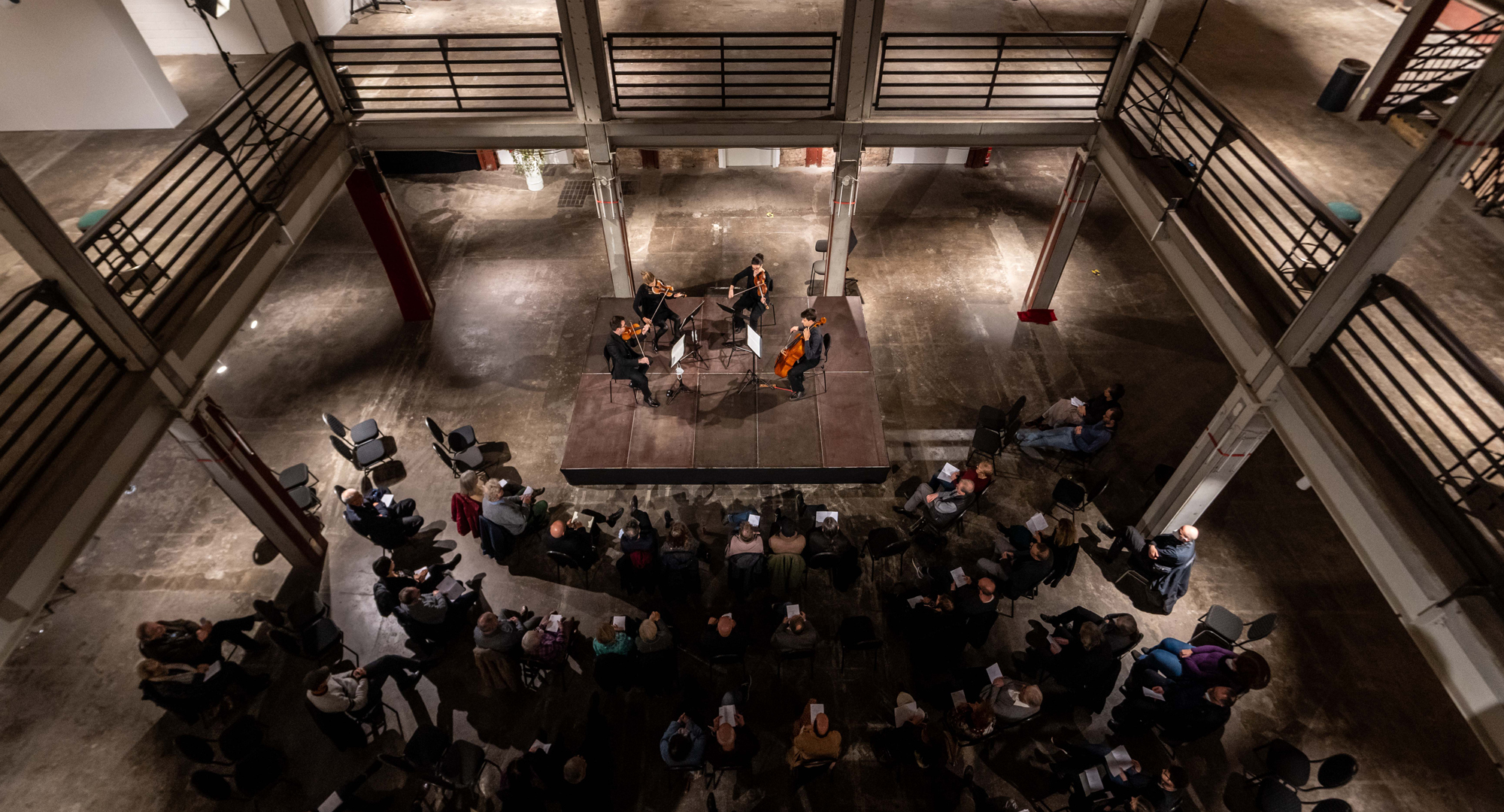
How do we maintain our composure and sense of humour in the face of imminent catastrophes? The question is aimed at a survival strategy not only for mankind, but for nature as a whole. It is always topical, and it seems to be especially so today. It was no less topical in 1939. One of the man-made disasters, the Second World War, was imminent. Four compositional heavyweights from the first half of the 20th century make their mark in today’s concert, two of them directly from 1939. Two others “play” with listeners’ expectations in the 1920s – and again in the 2020s. The “roaring twenties” were the birth of radio in Germany and thus also of the Rundfunk-Sinfonieorchester Berlin. The orchestra celebrated its centenary in the 2023/2024 season. Today’s chamber concert with works by Zemlinsky, Milhaud, Weill and Hindemith, among others, summarises four composers who are directly connected to the history of the orchestra – at the time as interpreters of their own works. In addition, the concert once again provides food for thought for the future of radio and concert music in the anniversary season: analogue music, literally created by living breath, meets digitally synthesised music created with the help of computer technology and electricity, brought in by RSB cooperation partner Catalyst – Institute for Creative Arts and Technology. Are the two worlds able to interact with each other? What role do creative people play in this?
You are welcome to find out!
Cooperation partner

Storytelling concert Shelly Kupferberg
Schubert, Tchaikovsky, Tiessen, Kupferberg
Moderated rehearsal with Dima Slobodeniouk & Xavier de Maistre
Saariaho